

 Reducing added sugar consumption and the growing demand for low-sugar and sugar-free products have made choosing a suitable sugar substitute an important consideration for consumers and food manufacturers. However, sweeteners do not all perform in the same way. An option suitable for sweetening tea may not necessarily deliver the desired results in cakes, chocolate, or hard candy.
Sugar contributes more than sweetness to food products. It also affects volume, texture, color, moisture, shelf life, and thermal behavior. Therefore, choosing the best sugar substitute requires an evaluation of the product type, formulation objective, sweetness intensity, energy content, blood glucose response, and labeling requirements. In this article, we compare different sugar substitutes and explain the most suitable applications for each category.
Why Are Sugar Substitutes Used?
The World Health Organization recommends limiting the intake of free sugars throughout life. Free sugars include sugars added to foods and beverages by manufacturers, cooks, or consumers, as well as sugars naturally present in honey, syrups, fruit juices, and fruit juice concentrates.
Sugar substitutes may be used for several purposes:
- Reducing the added sugar content of a product
- Producing low-sugar or sugar-free products
- Reducing the energy content of a formulation
- Reducing the post-consumption blood glucose response
- Developing tooth-friendly products
- Improving stability against heat or moisture
- Meeting market demand for diet and health-oriented products
Achieving any of these objectives requires the appropriate selection of ingredients and careful reformulation. The presence of a sugar substitute alone does not guarantee that the final product is low-calorie, suitable for people with diabetes, or nutritionally superior.
Is One Sugar Substitute Suitable for Every Product?
No. There is no single sugar substitute that is best for every application. Sugar performs several functions simultaneously in food formulations:
- Providing sweetness
- Supplying bulk and total solids
- Helping create texture
- Participating in browning reactions
- Controlling water activity and shelf life
- Affecting the freezing point
- Supporting structure formation in baked products
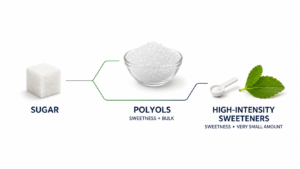
High-intensity sweeteners such as stevia and sucralose can provide sweetness in very small amounts, but they do not replace the bulk lost when sugar is removed. In contrast, polyols such as isomalt, sorbitol, erythritol, and xylitol provide sweetness while also replacing some of the required product volume.
Important note: Replacing sugar is generally not a one-to-one process. Many products require a combination of a bulking sweetener and a high-intensity sweetener to provide the required sweetness, texture, and total solids simultaneously.
Types of Sugar Substitutes
1. Polyols or Sugar Alcohols
Polyols are a group of carbohydrates that generally provide less sweetness and energy than sucrose. Despite their name, they do not contain the type of alcohol found in alcoholic beverages. Isomalt, sorbitol, erythritol, xylitol, maltitol, and mannitol are among the best-known members of this group.
Because of their bulking properties, polyols are used in candies, chocolate, chewing gum, biscuits, pharmaceutical formulations, and other low-sugar and sugar-free products. Their sweetness, solubility, moisture absorption, cooling effect, and gastrointestinal tolerance vary.
2. High-Intensity Sweeteners
These ingredients are many times sweeter than sugar, so only a small amount is required to create a sweet taste. Stevia, sucralose, acesulfame potassium, aspartame, and saccharin belong to this category.
High-intensity sweeteners generally do not provide the bulk of sugar. Therefore, in products such as cakes, chocolate, and candies, they may be used alongside polyols, fibers, or other bulking ingredients. Their selection should consider heat stability, aftertaste, processing conditions, and target-market regulations.
3. Sugars With Different Metabolic Properties
Some ingredients are chemically classified as sugars, but their absorption or metabolism differs from that of sucrose. Allulose, tagatose, and isomaltulose are examples of this category.
These ingredients should not be treated as identical to non-caloric sweeteners or polyols. Their nutritional characteristics, energy contribution, sweetness intensity, and regulatory status differ.
4. Natural Sweeteners Containing Sugar
Honey, date syrup, grape syrup, maple syrup, and fruit concentrates are sometimes introduced as natural alternatives to sugar. These ingredients may have different flavors and accompanying compounds, but they still contain sugars and provide energy.
A sweetener being natural does not mean it is sugar-free, calorie-free, or suitable for everyone. According to the World Health Organization’s definition, sugars present in honey, syrups, and fruit juices are also considered free sugars.
Comparison of Different Sugar Substitutes
The sweetness values in the following table are approximate and may vary depending on the ingredient grade, temperature, acidity, accompanying ingredients, and product type.
| Sugar substitute | Approximate sweetness compared with sugar | Bulking ability | Important characteristic | Common applications |
|---|---|---|---|---|
| Isomalt | Approximately half as sweet as sugar | Yes | Low hygroscopicity and suitable heat stability | Hard candy, confectionery decorations, chocolate, and pharmaceutical products |
| Sorbitol | Less sweet than sugar | Yes | Moisture retention and preservation of product softness | Chewing gum, bakery products, toothpaste, and pharmaceutical products |
| Erythritol | Less sweet than sugar | Yes | Very low energy contribution and a cooling sensation | Beverages, tabletop sweeteners, and blended products |
| Xylitol | Close to the sweetness of sugar | Yes | Suitable sweetness and use in tooth-friendly products | Chewing gum, candy, oral care products, and tabletop sweeteners |
| Stevia | Several hundred times sweeter than sugar | No | Used in very small amounts and may produce an aftertaste | Beverages, dairy products, and sweetener blends |
| Sucralose | Approximately 600 times sweeter than sugar | No | High sweetness intensity and use in various formulations | Beverages, dairy products, desserts, sauces, and certain baked products |
| Isomaltulose | Approximately half as sweet as sugar | Yes | A digestible sugar absorbed more slowly than sucrose | Beverages, sports products, and energy products |
| Honey and natural syrups | Variable | Yes | Contain sugar and provide energy | Beverages, desserts, traditional products, and bakery products |
A Closer Look at the Most Important Sugar Substitutes
Isomalt: Suitable for Candy and Confectionery Products
Isomalt is a bulking polyol with a lower sweetness intensity than sucrose. Its low hygroscopicity, suitable heat stability, and reduced tendency to brown make it a practical option for hard candies, transparent confectionery decorations, coatings, and certain chocolate products.
Because isomalt is approximately half as sweet as sugar, it may be combined with a high-intensity sweetener to achieve the desired sweetness. Its solubility, processing temperature, and cooling conditions should also be considered during product development.
Sorbitol: Suitable for Moisture Retention and Softness
Sorbitol provides sweetness and bulk while also acting as a humectant. This property can help maintain a soft texture in chewing gum, cakes, pharmaceutical products, and personal care formulations.
The higher moisture absorption of sorbitol can be an advantage in certain products and a limitation in others. For example, a property that helps keep a cake soft may not be desirable in a hard candy that must remain stable against moisture.
Erythritol: Low Energy With a Cooling Effect
Erythritol is a polyol with a very low energy contribution and a low blood glucose response. Because of its crystalline structure and negative heat of solution, it can create a cooling sensation as it dissolves in the mouth.
This cooling effect may be desirable in chewing gum and mint-flavored products, but it may need to be controlled in chocolate, cakes, or products with warm flavor profiles. Combining erythritol with other sweeteners can help balance its taste and sweetness intensity.
Xylitol: Sweetness Close to Sugar
The sweetness intensity of xylitol is close to that of sucrose, and oral bacteria do not ferment it in the same way as sugar. It is therefore widely used in sugar-free chewing gum, candy, and oral care products.
Xylitol can also create a cooling sensation, and consuming large amounts may cause gastrointestinal effects in some individuals. It is also important to note that xylitol is highly toxic to dogs, so products containing it must be kept away from pets.
Stevia: High Sweetness Without Bulk
Steviol glycosides are sweet compounds extracted and purified from the stevia plant. They have a very high sweetness intensity and are therefore used in small amounts in food formulations.
Stevia does not replace the bulk of sugar and may produce bitter, herbal, or licorice-like notes at certain concentrations. For this reason, it is often blended with polyols or other sweeteners.
Sucralose: A High-Intensity Sweetener
Sucralose is considerably sweeter than sugar, and a small quantity can provide the required sweetness. It is used in beverages, dairy products, desserts, sauces, and certain baked products.
Like other high-intensity sweeteners, sucralose does not replace the bulk or structure provided by sugar. Solid formulations therefore generally require an appropriate bulking ingredient.
What Is the Best Sugar Substitute for Tea and Coffee?
Bulking is not particularly important in tea and coffee because the primary objective is to create a sweet taste. High-intensity sweeteners, erythritol, xylitol, or a blend of different sweeteners may therefore be considered.
The final choice depends on personal preference, the desired sweetness level, and acceptance of any aftertaste. Honey and natural syrups can also sweeten beverages, but they still contain sugar and energy and are not sugar-free substitutes.
What Is the Best Sugar Substitute for Baking?
Removing sugar from cakes and bakery products is more challenging than sweetening a beverage. Sugar affects aeration, volume, crust color, moisture, softness, and shelf life in these products.
A multi-component system often provides better results in this application. A polyol or another bulking ingredient can supply some of the required solids, while a high-intensity sweetener adjusts the sweetness. Changes to the amount of liquid, fat, browning ingredients, and baking time may also be necessary.
What Is the Best Sugar Substitute for Chocolate and Candy?
In hard candies, resistance to moisture, transparency, melting behavior, and the formation of a glassy structure are important. Because of its low hygroscopicity and suitable stability, isomalt is a recognized option for this application.
In chocolate, particle size, melting behavior, viscosity, mouthfeel, and cooling effects must be evaluated. Maltitol, isomalt, erythritol, and combinations of these ingredients may be used depending on the product. However, directly replacing sugar without adjusting the formulation does not always provide an acceptable result.
What Is the Best Sugar Substitute for Chewing Gum and Oral Care Products?
Xylitol, sorbitol, mannitol, and isomalt are commonly used polyols in chewing gum and oral care products. The choice among them depends on sweetness intensity, moisture absorption, cooling effect, texture, and formulation cost.
Before using claims such as “sugar-free” or “tooth-friendly,” manufacturers must review the final formulation and the regulations of the target market. The presence of a polyol alone is not sufficient to support every nutrition or health claim.
Sugar Substitutes for People With Diabetes
Some polyols and high-intensity sweeteners generally do not produce the same rapid increase in blood glucose as sucrose. However, whether a product is suitable for people with diabetes cannot be determined solely by the type of sweetener it contains.
The total carbohydrate content, serving size, other ingredients, and the individual’s dietary plan are also important. Honey, date syrup, grape syrup, and other natural syrups still contain sugar and should not be consumed without considering their carbohydrate content.
People with diabetes should review the complete nutrition label and make their choices according to their dietary plan and the recommendations of a physician or qualified nutrition professional.
Can Sugar Substitutes Help With Weight Loss?
Replacing sugar with ingredients that provide less energy may reduce the energy content of a particular formulation. However, weight loss depends on the complete dietary pattern, serving sizes, physical activity, and individual factors.
The World Health Organization guideline advises against using non-sugar sweeteners as a long-term strategy for weight control or reducing the risk of noncommunicable diseases. This recommendation applies to non-sugar high-intensity sweeteners such as stevia, sucralose, and aspartame and does not include polyols.
Therefore, “sugar-free” should not be interpreted as “causes weight loss.” The product’s total energy content and serving size remain important.
Possible Side Effects of Sugar Substitutes
Approved sweeteners are evaluated under the conditions and limits established by regulatory authorities. However, the ingredient type and amount consumed can affect individual tolerance.
- Large amounts of certain polyols may cause bloating, abdominal discomfort, or a laxative effect.
- Some people may dislike the aftertaste of stevia or certain high-intensity sweeteners.
- Products containing aspartame must include an appropriate phenylalanine warning for people with phenylketonuria.
- Xylitol is highly toxic to dogs and must be kept away from pets.
- Permitted uses and regulatory requirements for sweeteners vary between markets.
For products containing significant amounts of polyols, requirements related to laxative-effect warnings should be reviewed according to the regulations of the target market.
Selecting a Sugar Substitute for Industrial Formulation
Before selecting a sweetener for an industrial product, the following questions should be answered:
- Is the objective to remove sugar completely or only reduce it?
- Does the product require the bulk and total solids provided by sugar?
- What sweetness intensity is required?
- Is browning desirable in the product?
- Is the selected ingredient stable at the processing temperature and pH?
- How does it affect texture, viscosity, and mouthfeel?
- Does it create a cooling effect or aftertaste?
- How does it affect water activity and shelf life?
- What level of gastrointestinal tolerance is expected?
- What are the labeling requirements in the target market?
- Does the ingredient have the appropriate grade and purity?
After the initial selection, laboratory testing, pilot production, sensory evaluation, and shelf-life assessment are necessary. In addition to reducing sugar, a successful formulation must provide acceptable taste, texture, stability, and consumer acceptance.
The Difference Between “Sugar-Free” and “No Added Sugar”
The terms “sugar-free,” “no added sugar,” “low-sugar,” and “low-calorie” are not interchangeable. A product may contain no added sugar but still contain sugars naturally present in its ingredients. Similarly, a sugar-free product is not necessarily free from carbohydrates or energy.
The conditions for using these claims must be evaluated according to the final product composition and the regulations of the destination country. The sweetener’s name or additive number should also be declared in the ingredient list according to applicable requirements.
Which Sugar Substitute Is Ultimately the Best?
The answer depends on the intended application. For tea and coffee, a high-intensity sweetener or tabletop blend may be sufficient. For candy, chocolate, and bakery products, bulk, texture, and processing behavior must be reconstructed in addition to sweetness.
Isomalt is suitable for products where low hygroscopicity and heat stability are important. Sorbitol can be useful when moisture retention and softness are desirable. Erythritol provides very little energy, but its cooling effect must be controlled. Stevia and sucralose provide high sweetness intensity but require other ingredients to replace the bulk of sugar.
In many industrial formulations, using a blend of sweeteners is the most effective approach because one ingredient alone cannot reproduce all the functional properties of sugar.
Conclusion
Choosing a sugar substitute should not be based only on sweetness intensity. The product type, functional role of sugar, energy content, blood glucose response, heat stability, moisture absorption, texture, and labeling regulations all influence the final choice.
Polyols can replace some of the bulk of sugar, while high-intensity sweeteners increase sweetness in very small amounts. Natural sugars such as honey and syrups still contain sugar and energy and should not be treated as equivalent to sugar-free sweeteners.
For assistance with selecting suitable ingredients, obtaining technical information, evaluating samples, or developing a formulation, contact the Shirin Salamat technical team.
Frequently Asked Questions About Sugar Substitutes
What Is the Healthiest Sugar Substitute?
No single option can be identified as the healthiest sugar substitute for every person and application. The amount consumed, individual health status, complete product composition, and intended use should all be considered.
What Is the Best Sugar Substitute for Tea?
Stevia, sucralose, erythritol, xylitol, and tabletop blends can be used to sweeten tea. The final choice depends on personal preference, required sweetness intensity, and individual circumstances.
Is Honey a Sugar-Free Substitute for Sugar?
No. Honey is a natural ingredient, but it still contains sugar and provides energy. Under the World Health Organization’s definition, sugars found in honey are classified as free sugars.
Can Stevia Be Used in the Same Amount as Sugar?
No. Steviol glycosides are several hundred times sweeter than sugar and are used in much smaller quantities. Stevia also does not provide the bulk of sugar, so solid products generally require reformulation.
Which Sugar Substitute Is Better for Baking?
The choice depends on the product. In many bakery formulations, combining a bulking ingredient such as a polyol with a high-intensity sweetener provides better results. Temperature, texture, color, and product moisture should also be evaluated.
Can Sugar Substitutes Cause Digestive Effects?
Consuming large amounts of certain polyols may cause bloating, abdominal discomfort, or a laxative effect in some individuals. Gastrointestinal tolerance depends on the ingredient type, amount consumed, and individual condition.
Are Sugar-Free Products Suitable for People With Diabetes?
Not necessarily. The total carbohydrate content, serving size, and other ingredients should also be considered. People with diabetes should review the nutrition label and make decisions according to their dietary plan.